Project
CHANGE: Capitalizing on the Human Dimension Mandate to Advance Gender Equality
Quick links
- Project period:
- 01/06/2022 - 31/03/2027
- Implemented by:
- OSCE Office for Democratic Institutions and Human Rights
- Fields of work:
- Democratization, Human rights, Roma and Sinti, Education, Gender equality
Overview
The CHANGE project supports efforts to make societies safer and more equal for women.
It works with civil society, public institutions, political leaders and human rights defenders to turn ideas into change.
The focus is on practical solutions that address the root causes of inequality and improve everyday experiences for women.
The project is currently active in Georgia, North Macedonia, Poland and Uzbekistan.
Budget and timeline
The project has a total budget of EUR 3,190,000 and runs from 1 June 2022 to 31 March 2027.
The project is funded by the Czech Republic, Bulgaria, Germany, Finland, France, Italy, Norway, Slovenia, Spain, Sweden, the United Kingdom and the United States.
Factsheet
Launched in 2021, ODIHR’s CHANGE project works to improve gender equality, women’s rights and safety by tackling the barriers that still exist.
Newsletter
The CHANGE Update newsletter informs about our activities and resources.
To subscribe and find out more, contact change@odihr.pl.
Roma and Sinti women in public life
Empowering women from underrepresented groups to find their voices and advocate for their rights and the rights of other women is key to achieving more just and equal societies.
Speaking out for yourself
In this video, Roma women and activists from Poland explain how self-advocacy and leadership skills can help increase their opportunities for equal participation in public life.
ODIHR’s CHANGE project is focusing on building these skills.
Turning voices into change
Across Europe and beyond, Roma and Sinti women are shaping change in many different ways — in politics, international institutions, civil society, culture and their communities.
Some open doors where none existed before. Gjulistana Jumerovska-Markovska became one of the first Roma women in parliament in North Macedonia, showing that Roma women belong where decisions are made. Others build on that path at the European level. Lívia Járóka, the first Roma woman elected to the European Parliament, helped bring Roma inclusion into European policymaking.
Change also takes shape through persistence within institutions. Rita Izsák-Ndiaye has worked across the UN, OSCE and diplomatic service to strengthen international standards on minority rights, while Sara Giménez Giménez has spent decades turning advocacy into concrete reforms, from anti-discrimination laws to national-level policy change.
And change does not happen through politics alone. Esma Redžepova-Teodosievska used culture, music and public visibility to challenge stereotypes and bring dignity and recognition to Roma identity.
Across all these paths — from local activism to international diplomacy, from cultural leadership to political representation — a common thread runs through their work: the determination to be heard, to be included, and to create space for others.
For many, this work is deeply personal. Rooted in lived experience, it reaches far beyond it — shaping institutions, influencing policies and strengthening communities. Change is not one moment or one achievement. It is built over time, across generations and across different spaces — through courage, persistence and the refusal to accept exclusion.
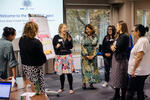
At the conference “Roma and Sinti Women in the Public Sphere: Turning Voices into Change” (Warsaw, 2–3 December 2025), participants were invited to nominate women they see as role models in politics and public life. The profiles you see here reflect those choices — voices of inspiration identified by the participants themselves. Some of these women were also present at the meeting, bringing these stories of change into the room.
Originally presented as a poster exhibition during the conference, these profiles challenge the persistent perception that Roma and Sinti women are absent from public life. Instead, they show the many ways women contribute, lead and shape change across different spaces.
We are now sharing them here as a collection.
👉 Explore the full set of profiles.
Resources
Explore a range of practical resources designed to support gender equality and women’s participation in public and political life.
From guides and toolkits to research and reports, these materials offer clear, hands-on approaches to addressing violence, strengthening inclusion and supporting women across different areas of public life.